
 admin
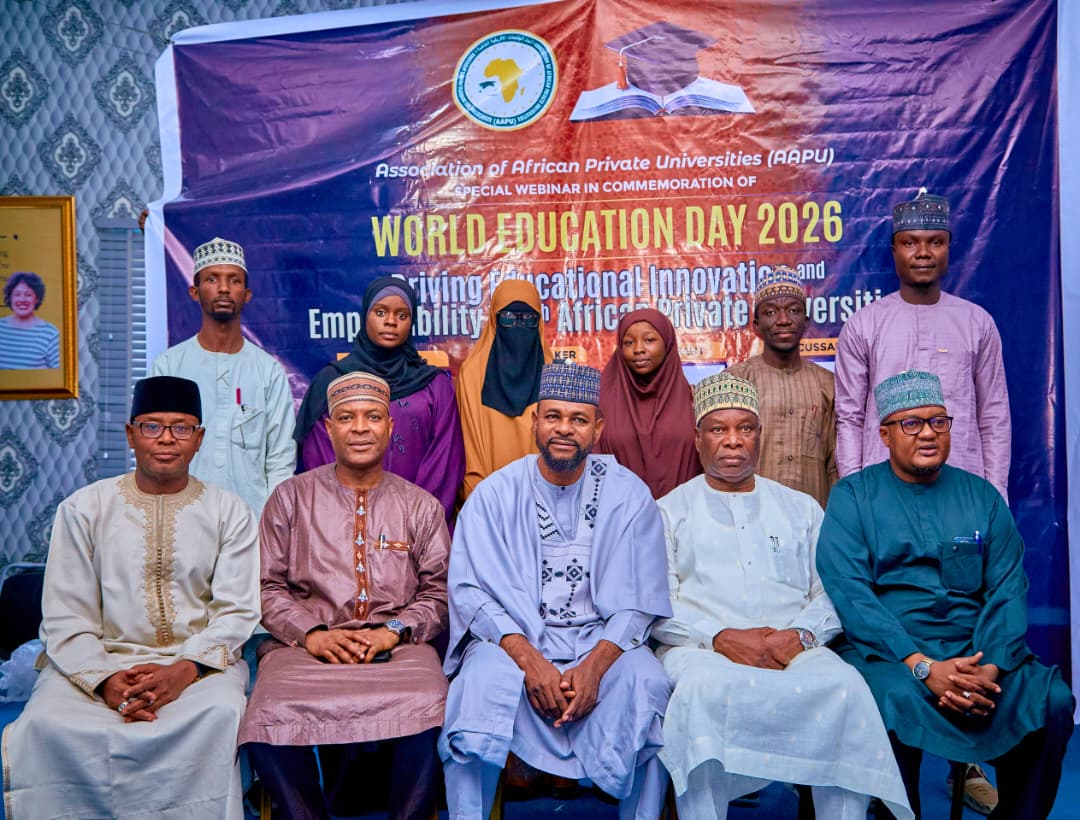
adminThe Association of African Private Universities (AAPU) successfully hosted a high-impact virtual webinar to commemorate World Education Day 2026, bringing together leading education stakeholders to deliberate on the future of innovation and graduate employability across Africa.
Held on 24th January 2026, the webinar was themed “Driving Educational Innovation and Employability Through African Private Universities” and attracted over 600 participants from 35 countries, including academics, policymakers, students, development partners, and private-sector stakeholders from Africa and beyond.
In his opening remarks, Prof. Adamu Abubakar Gwarzo, President and Convener of AAPU, emphasized the growing responsibility of African private universities to move beyond traditional teaching models and focus on producing highly skilled, adaptable, and employable graduates through innovation-driven education. Represented by the AAPU Secretary-General, Prof. Abubakar Sadiq Haruna, Prof. Gwarzo highlighted the urgent need for institutions to align academic programmes with labour-market demands, industry expectations, and emerging global skills.
Delivering the keynote address, Prof. Sudhakar Kota, Vice-Chancellor of Hensard University, underscored the importance of curriculum reform, strong industry partnerships, and technology-enabled learning models as critical pathways for improving graduate employability and workforce readiness in Africa.
Earlier sessions were led by Prof. Cherno Omar Barry, Dr. Zubaida Ahmad Nagee, and Engr. Muftawu Sanusi, with discussants drawn from the United States, Uganda, Ethiopia, Ghana, Nigeria, and the United Kingdom. The panel examined policy coherence, learner-centred pedagogical models, digital transformation, and infrastructure development as core drivers of sustainable educational innovation.
Speaking during his session, Prof. Cherno Omar Barry called on African private universities to leverage diverse global education models and best practices to transform teaching and learning outcomes. He stressed that institutions must move beyond producing certificate-holding graduates to nurturing competent professionals, problem-solvers, entrepreneurs, and future employers who can actively contribute to economic growth and job creation.
In her presentation, Dr. Zubaida Ahmad Nagee highlighted the significant progress made in recent years, particularly in advancing women’s access to education across Africa. She further emphasized the importance of recognizing the informal sector as a key driver of economic development, noting that education plays a vital role in equipping individuals with practical skills that support entrepreneurship, community development, and inclusive growth.
Contributing to the digital transformation discourse, Engr. Muftawu Sanusi spoke on the theme of “Building Digital-First African Private Universities: Infrastructure as the Backbone of Innovation and Employability.” He emphasized the need for institutions to invest in modern digital infrastructure, smart campuses, learning management systems, data platforms, and secure connectivity to enable blended learning, remote collaboration, skills-based training, and technology-driven innovation ecosystems that prepare students for the digital economy.
Among the featured speakers, Dr. Habib Awais, Vice President (Administration) at Maryam Abacha American University of Nigeria (MAAUN), spoke on the importance of robust institutional governance, transparent administration, and efficient management systems in creating an enabling environment for innovation and sustainable academic growth.
Similarly, Dr. Abdullahi Garba, Coordinator of General Education at MAAUN, emphasized the value of broad-based general education in equipping students with critical thinking abilities, adaptability, communication skills, and lifelong learning competencies required in today’s dynamic labour market.
In separate remarks, Dr. Salisu Muhammad, Executive Director of the Africa Institute for Solutions and Development, called for deeper collaboration between universities, industry players, policymakers, and development institutions to bridge the gap between academic training and workforce requirements. Meanwhile, Engr. Bashir Garba, Head of Communications at AAPU, highlighted the strategic role of effective communication, digital outreach, and knowledge dissemination in amplifying innovation efforts and strengthening the visibility of private universities across the continent.
The webinar also featured a dynamic contributors’ panel and an interactive question-and-answer session, allowing participants to share perspectives, best practices, and policy recommendations aimed at strengthening Africa’s higher education ecosystem.
In his closing remarks, Prof. Abubakar Sadiq Haruna, AAPU Secretary-General, reaffirmed the association’s commitment to promoting quality assurance, relevance, innovation, and institutional excellence across African private universities. He further reiterated AAPU’s resolve to continue creating platforms that foster collaboration, capacity building, and policy engagement in support of sustainable educational development across the continent.


